Sunday, July 24, 2011

Big Deal

Big Sur River Gorge 
Life along the Big Sur River Gorge
Big Sur, Calfornia. Few sensory pleasures compare to dipping into a cool mountain river on a scorching hot summer day. During my past four years in California, this has been my ultimate indulgence. To get away from the hustle and bustle of life for a day, bake in California's warm interior on a scenic hike or bike ride, and then spend the rest of the day drifting in pure bliss within crystal clear mountain waters - is a pleasure hard to put words to. A favorite spot in the past has been the Russian River of Sonoma Valley, but the Big Sur River in July does the job just fine. Recently, my buddy "Rabbit" Schaffer and I made our way to Pfeiffer Big Sur State Park and did a few hours of hiking on the dramatic - but terribly exposed - Mount Manuel trail. After a few hours baking in the Big Sur July heat along windless canyons of the Ventana Wilderness, we made our way back to the Park, scrambled down into the Big Sur River gorge and rock-hopped upstream until we found a swimming hole to our liking. Crystal clear, these waters are important for steelhead and were all too recently a favorite haunt for California's now extinct grizzly bear population. For us, it was summertime at its best. A swim beneath waterfalls, followed by sipping a few rounds of Argentine mate upon massive boulders, and then more swimming. Before long, all of the biting flies, snakes, poison oak and scorching sun of the Ventana backcountry had been washed from our souls. Heaven must be a little like this.

View Larger Map

 
Big Sur River swimming hole
Big Sur River


Arlo sipping mate - Big Sur River Gorge
Arlo sipping mate in the Big Sur River Gorge
Rabbit on Mount Manuel
Rabbit runs down the Mount Manuel Trail
Rabbit & his mate
Rabbit sipping mate in the Big Sur River Gorge
Arlo & Rabbit, Big Sur River
Arlo & Rabbit relax in the Big Sur River - post excursion

Thursday, March 24, 2011

Exploration as Art

A blind river fish from the Rio Bameno, Amazonian Ecuador.  Known as "wiami" to the local Huaorani.
Mountain View, California.  Beyond all else, exploration is my greatest passion. It is the process of discovery with risk. It provides the opportunity to experience what few others have and the potential to witness that which no one else has. It is both the hazy cloud of the unknown and the shining beacon of enlightenment. And to me it is worth any cost.

Unidentified mantis at the Bilsa Biological
Station.  Mache-Chindul Range,
Western Ecuador.
Exploration is an art. Like all forms of art, it is a means of self-expression, discovery and a reflection of reality. It is also the tool by which I paint the picture of my life. The means through which I tell stories in written word and film. It is an ever-changing landscape on a kaleidoscope of color, culture, geology, climate and biodiversity. It is a deep crevasse of self-awareness, the mechanism for finding one’s own place in this world and understanding the texture of our souls. Nothing shows you who you are quite like that which you are most not. Exploration places you in intimate proximity with your counterbalance. It entwines who you are with who you are not, with who you may be and most of all, who you appear not to be, but in fact share almost everything. In doing so, exploration catalyzes the creation of something new. This creation is artistic expression of life in its purest form.

The author, Arlo Hemphill, straddled with a killed peccary during a hunt with the Huaorani.  Amazonian Ecuador, 2003.

Tuesday, March 22, 2011

I am Wilderness

Pico Blanco, Ventana Wilderness, California.  July 2009.
Words describe my connection to wild places, my symbiosis with the wilderness.  I am wilderness.  My soul is those wild, lonely places - windswept mountain passes, the rocky crags, and wandering herds upon endless grasslands.  There is no difference between those things and what is found within me.  This is true too of the sea.  The vibrant blue of tropical waters.  I am but a damselfish in an ocean of coralline hues. The schools of great fish swim through my heart and onto the deserts of my mind - those Forgotten Lands, bone dry - but bright and welcoming.  Bring your own water, for I have none to give.  I am wilderness.

Tuesday, February 1, 2011

"Postive News" on Bottom Trawling

TASMAN SEA: The NZ dep sea trawler West Bay does a fast turn after hauling its catch from international waters in the Tasman Sea. Greenpeace along with more than a thousand scientists are supporting the call for a moratorium on high seas bottom trawling, because of the vast amount of marine life that is destroyed by this fishing method.  © 2004-Greenpeace/Roger Grace
Mountain View, California.  As one of the most destructive forms of fishing, any proactive efforts to limit or eliminate bottom trawling are good news.  This fishing practice systematically scrapes along the seafloor with heavy gear, causing widespread ecological damage.  The long term impact on fishing itself is the reduction of fishery populations and loss of fisheries habitat.  This, however, pales in comparison to the damage it does to greater environment, including to millennia old cold water corals - the fiscal value of which are incalculable.

In this quarter’s Positive News,  a U.K.-based international newspaper with affiliates in New York, Hong Kong, Madrid and Argentina, the author of this blog was interviewed on the international effort to ban deep sea bottom trawling on the high seas.  This auxillary article compliments the month’s feature story, which covers an announcement from the nation of Belize to ban bottom trawling in their national waters. Joining the ranks of Venezuela and Palau, both countries of which have taken similar measures, Belize put this legislation into effect on December 31, 2010.

Arlo's contribution covers some of numerous achievements made through an international campaign to promote a U.N. moratorium on high seas bottom trawling that was spearheaded by the Deep Sea Conservation Coalition.  He also touches on the momentum to build a network of marine protected areas on the high seas, which in concept would offer permanent protection to the seamounts and coldwater coral reefs currently threatened by trawling and other destructive fishing practices.

Read the full Positive News article: Towards and International Ban on Trawling by Sarah Wilkinson.

For more information on bottom trawling and high seas marine protected areas, check out the following sites:


Monday, January 24, 2011

Science on Ice

"The test of man's willingness to pull back from the destruction of the Antarctic wilderness is the test also of his willingness to avert destruction globally. If he cannot succeed in Antarctica he has little chance of success elsewhere." - Edwin Mickleburgh

Many of us dream of going to Antarctica. A few of us have had the good fortune of visiting. For Dr. Rodolfo Werner, travel to White Continent is a regular part of life. As a marine scientist, Dr. Werner has spent much of his life studying marine mammals of the Southern Ocean and the Southwest Atlantic, off of Argentina's wild Patagonian coast. These days, he's the scientific advisor for the Pew Environment Group's Antarctic Krill Conservation Project. Much of his time is spent in the political sphere, where he provides scientific support for the case of protecting key areas used by Antarctic wildlife to forage on krill - a shrimp-like crustacean that forms the basis of the Antarctic food chain.  But when not hammering out new protections for Antarctic wildlife, his life is on ice - literally.

During the Antarctic summer, when much of the northern hemisphere is blanketed in snow, Rodolfo guides groups to Antarctica as an expedition leader with National Geographic's Lindblad Expeditions.
Currently at sea on the National Geographic Explorer, Rodolfo's Antarctic voyage can be followed online.  Drop in for your own taste of this icy realm.

Monday, January 17, 2011

Sunsets of Big Sur

Sunset over the Pacific. Big Sur, California.
Big Sur, California.  For those who know me, you may be aware that the past few months have been a difficult time for me, amongst the hardest points on my life.  But before the recent drama began to unfold in force, the wilds of Big Sur were my frequent refuge of the soul.  This magnificent stretch of coastline, and its adjacent Ventana Wilderness, represents some of the most beautiful and untainted landscape in the continental United States.

Rabbit crosses a fallen redwood
in Julia Pfeiffer Burns State Park
Due to its close proximity to Monterey - with some hiking trails as short as a 15 minute car ride from downtown - this natural treasure has been my regular go to spot over the past two years for hiking, river swimming, natural history film and photography, writing, relaxation and reflection.  Luckily, fortune has also provided me with a good number of friends who find equal appreciation and fascination with this special place.  Most recently, I had visits from Rabbit Schaffer and Boca this past October and we took the opportunity to hit some trails, scramble up some river gorges and enjoy fantastic sunsets.

Here's a few photos from October.  I wish I was in Big Sur now.
McWay Falls, Julia Pfeiffer Burns State Park
Rabbit crosses the fallen redwood, Julia Pfeiffer Burns State Park
Big Sur Sunset
Rabbit, Big Sur. October 2010
Arlo Hemphill, Big Sur. October 2010.

Sunday, January 16, 2011

Of Frogs and Photos

Glass frog - Centrolene antioquensis
Photography is one of the most powerful tools for communicating the irreplaceable value of wilderness.   Conservation photographers bring the beauty, majesty and spiritual essence of remote wilderness areas  - as well as their diverse biological inhabitants - back to the everyday world.  Without images such as the few featured here, many in the "modern" world would have no understanding or sense of relationship to the remaining wilderness areas of our planet.  

Endangered Rothschild Giraffe, the only subspecies
with five  horns (two behind the ears!)  - less than 690
individuals survive in the wild, many of them around Giraffe Manor
An emerging talent in this discipline is Robin D. Moore.  Dr. Moore works as a herpetologist - or frog expert - for Conservation International.   His job entails traveling to some of the most far flung corners of the globe to check in on the status of declining amphibian populations.  He takes advantage of these opportunities in the field to record the places, faces and animals he encounters through photography.  And thanks to his great talent in this area, he brings back images so compelling, they tell the story of his important work - with little need for words.

To see more of Robin's work, visit his photography website at robindmoore.com and follow him on Facebook at Robin Moore Conservation Photographer.

Blog author Arlo Hemphill and Robin Moore
enjoy a lighter  moment at an iLCP "12 Shots" event
during Wild9 in Merida, Mexico - Nov 2010


Friday, December 17, 2010

Shark Sucker


Beqa Lagoon, Fiji.  This past July I had the wonderful opportunity of traveling to Fiji and diving with the shark feeders of Beqa Lagoon.  To the people of Beqa, sharks are sacred spirits with whom they share a special relationship.  Divers visiting Fiji may accompany the islanders on a shark feeding for an up close and personal look at bull, silvertip, tawny nurse, blacktip reef, whitetip reef and tiger sharks.

The above picture is one of my favorite from the experience.  This is one of the Fijian divers ascending to the surface following the shark feeding.  The fish swarming around him are primarily remoras and rainbow runners, attracted to the remaining food in his feed bucket.   Ocean conditions were extremely excellent this day, offering top to bottom visibility at 100ft of water.  This is the kind of scene I can lurk in forever.  I never want to leave the blue on warm, clear days like this.

Tuesday, August 17, 2010

Big Sur Rattlesnake

Western Rattlesnake, Crotalus oreganus
Andrew Molera State Park, California. This past weekend I was out hiking near Big Sur with a group of friends from Monterey, and came across this western rattlesnake, Crotalus oreganus.  The poor guy was really upset to see us and not very cooperative in moving aside so we could pass. We were ascending the East Molera Trail in Andrew Molera State Park.  I encountered a second rattlesnake that afternoon on the Molera Ridge Trail.

Thursday, August 5, 2010

The Great Marlin Race: “ Billfishers, billfishers, billfishers, start fi...

The Great Marlin Race: “ Billfishers, billfishers, billfishers, start fi...: "The tournament began promptly at 7:30 a.m. this morning, under hazy skies with west winds around 7 mph. Randy and I met the anglers on the ..."

Tuesday, January 19, 2010

Big Asilomar

Monterey, California.  Terrific storm systems have been moving through Monterey Country for the past couple of days, generating tons of rains, hail, lightening strikes and a really big swell.  The storm system, which is expected to persist for awhile, is believed to be a result of the strong El Niño event rocking our world this year.  Below is a little video footage from one our local surf breaks, Asilomar, maxing out at 35ft this morning.


Thursday, January 7, 2010

Speak Wild

Merida, Yucatan, Mexico. This past November, this inspiring young man spoke at Wild9 in the Yucatan, Mexico:

Wednesday, October 14, 2009

MPAs Work

A long overdue message from Pierce Brosnan and friends:

Sunday, October 4, 2009

Elk Rut

Rocky Mountain National Park, Colorado. Last weekend I had the wonderful opportunity of camping and filming within Rocky Mountain National Park during the elk rut. Here is a small teaser of the footage - more to come!


Wednesday, June 10, 2009

An After Work Hike

Soberanes Canyon Trail, Garrapata State Park, California.  Location of trailhead: Latitude 36.4387, Longitude -121.9203. 

The signs at the trailheads in this region warn of mountain lions, rattlesnakes and poison oak.  I seem to be impervious to the latter and am only exhilarated by the possibility of seeing the first two.  I consider these types of signs to be more about the “best stuff to see” as opposed to any message of caution I should heed.  A few years back, while hiking at Kenai Glacier in Alaska, I was amazed and amused by the bear warning signs posted by the National Park Service.  Apparently, if at any times a bear “begins to feed on you”, you should “fight back”.  Brilliant!    To be fair though, the rest of the sign did give some pretty good advice as well as helpful information on the behavioral differences between black and brown bears.  
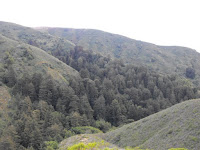
Now, on the trails here in Central California,  I did end up seeing one of those rattlesnakes.  It was this past Easter, while on a hike through Garland Ranch Regional Park, in Carmel Valley.  It was a small guy, for sure, but my very first rattler, so I was thrilled.  Today, on the other hand, I had no such luck, but nonetheless was not left disappointed.

After leaving work at 5pm in Monterey, I headed down the PCH past Carmel Heights to a beautiful ocean overlook where the trailhead for Soberanes Canyon Trail begins.  You enter Garrapata State Park as soon as you walk off the road, but this is evident only from a single sign post – there are no facilities or elaborate trail markers here.  The trail winds up the canyon, following a stream along the way and , at this time of day, the air was buzzing with damselflies and stellar jays.  After briefly passing through oak chaparral, the canyon winds through a valley of prickly pear cactus, through some riparian vegetation and then empties into a magnificent redwood forest a la the moon of Endor (minus any signs of Ewoks).  

After spending some time among the redwoods, billows of fog began to roll in and the sky darkened with the approaching dusk.  I had a mind to turn around, but noted that a few couples that passed me by while I stopped for photos had not come back this way.  So, I guessed a loop trail and moved onward.  I was greatly rewarded, as the best was yet to come.  The trail eventually rises up from the redwood forest and onto the grassy slopes above tree line.  From this vantage point, one can see how the redwood groves line the interiors of narrow canyons, and then quickly fade off as the slopes open up.   The trail here rises high into the Santa Lucia Mountains, the slopes of which are alive with wildflowers at this time of the year.  California poppies, composites and lupines were a few I recognized, but my recollection does not do them justice.  It is a orgy of color up there and, as one climbs higher, a spectacular vista of the sea opens behind you, making the Pacific look like nothing more than a great, glassy pond. 

Continuing upward, I feared that I had chosen wrongly as dusk settled deep on the backside of the mountain.  But as I neared the summit, a still late afternoon sun greeted me, illuminating the rocky outcrops and flowered slopes in bright gold, scattered almost mystically through patches of fog.   Although far above the sea now, the bellows of sea lions could yet be heard, their raucous barking radiating from an offshore pair of islets.  I encountered a rabbit, a black-tailed deer and numerous western fence lizards. 

The descent is on the front side of the mountain, exposed to the sun and ocean, so barren of trees.  In one obscure spot, a carved bench sits on an outcropping.  Through a friend I heard that on one night of every week, hikers meet here with bottles of wine to watch the sun go down.   I had no wine, but the sun did set for me as I descended back down to the road.    Funny, I kind of regret not having been caught up there past dark - I’d love to still be roaming those hills.


Wednesday, May 13, 2009

Great White Shark Song

Monterey, California.  This one's just for fun.  This video is a bit dated now, but I just love the song and thought I'd share a little shark good will with you today.  Avoid that shark fin soup at all costs!

Tuesday, May 12, 2009

Scientists urge world leaders to respond cooperatively to Pacific Ocean threats

Monterey, California.  More than 400 leading scientists from nearly two-dozen countries have signed a consensus statement on the major threats facing the Pacific Ocean. The threats identified as the most serious and pervasive include overfishing, pollution, habitat destruction and climate change.

“This is first time the scientific community has come together in a single voice to express urgency over the environmental crisis facing the Pacific Ocean,” said Meg Caldwell, executive director of the Center for Ocean Solutions, who will present the statement on Wednesday, May 13 at 6:30 a.m. U.S. Eastern Time to government officials gathered at the World Ocean Conference in Manado, Indonesia. “The scientific community urges governments to respond now, cooperatively, to these threats before their impacts accelerate beyond our ability to respond.”

The consensus statement, entitled “Ecosystems and People of the Pacific Ocean: Threats and Opportunities for Action,” emerged from a scientific workshop in Honolulu hosted by the Center for Ocean Solutions in collaboration with the International Union for Conservation of Nature (IUCN) and Ocean Conservancy. The workshop was part of a broader
 effort by the three organizations to challenge countries throughout the Pacific region to improve the health of marine ecosystems by 2020.

In the consensus statement, the scientists warn that if left unchecked, the cumulative impacts
of overfishing, pollution and habitat destruction—exacerbated by climate change—could have
devastating consequences for coastal economies, food supplies, public health and political stability.

These threats affect all members of the Pacific Ocean community, said Stephen Palumbi, director of Stanford University’s Hopkins Marine Station and one of the principal organizers of the consensus statement. “Remarkable similarity exists between the major problems experienced in poor and rich countries alike, in populous nations and on small islands,” said Palumbi, a professor of biology and a senior fellow at Stanford’s Woods Institute for the Environment.

In addition to listing the serious environmental challenges facing the Pacific Ocean, the consensus statement also highlighted a set of potential solutions now being applied and tested at various scales throughout the region. Examples include the establishment of marine protected areas and the creation of economic incentives for activities that promote rather than degrade ecosystem health. “These efforts have shown remarkable success at local scales in maintaining biological and human economic diversity, particularly when applied with adequate levels of regulation and enforcement in place,” said Caldwell, a senior lecturer at Stanford Law School and at the Woods Institute. “These solutions are indicators of hope within an ocean of distress.”

The consensus statement was largely based on a synthesis of more than 3,400 scientific papers on the threats and impacts to the Pacific prepared by the Center for Ocean Solutions. The Pacific Ocean Synthesis provides “a roadmap by which governments might chart a new course of policy for the Pacific region,” said Biliana Cicin-Sain, a professor of marine policy at the University of Delaware and coordinator of the Global Forum on Oceans, Coasts and Islands, a multi-stakeholder network committed to advancing ocean issues within international agreements.

“The impacts of misuse of our ocean resources on our economy, our environment and our community can no longer be ignored,” said Gov. Sinyo Harry Sarundajang of the Indonesian province of North Sulawesi, whose capital Manado is hosting the World Ocean Conference. The governor will convene the event with Caldwell on Wednesday. “We must work together at the regional and transboundary levels to find solutions for improved management of our common ocean.”

The scientific consensus statement and synthesis can be found at the Center for Ocean Solutions website. Scientists interested in signing the consensus statement can send an email to POIstatement@stanford.edu.

Based in Monterey, Calif., the Center for Ocean Solutions is a collaboration of three leading marine science and policy institutions—Stanford University (through its Woods Institute for the Environment and Hopkins Marine Station), the Monterey Bay Aquarium and the Monterey Bay Aquarium Research Institute (MBARI). The center focuses on finding practical, enduring solutions to major challenges facing the oceans.

.


Monday, April 27, 2009

Catch National Geographic's Megabeasts!

Monterey, California.  The National Geographic Channel has yet another great program exploring our missing wilderness.  Death of the Megabeasts explores the disappearance of giant beasts that roamed our planet long after the fall of the dinosaurs.  Scientists look at a number of theories on why these animals disappeared, including the likely possibility that we ate them!  The show next airs on May 3rd at noon.
 

Sunday, April 26, 2009

The History of Mammoths

Monterey, California.  National Geographic reports that the first written reference to mammoths is in the ShĂȘn I King, a book by Tang-fang So, a minister of Emperor Wu of the Han Dynasty, who ruled China from 140 to 87 BCE. He wrote of the k'i shu, a gigantic, rodent-like creature that lived beneath the ice of the frozen north: “Its flesh weighs a thousand pounds and may be used as dried meat for food… its hair is about eight feet in length, and is made into rugs, which are used as bedding and to keep out the cold. The hide of the animal yields a covering for drums, the sound of which is audible over a distance of a thousand miles.” Eating mammoth flesh, he noted, was believed to be a remedy for fevers.

Check out this recreation of mammoth life from the National Geographic Channel:

Sunday, March 22, 2009

Bad Shrimp, Bad!

Did you know that shrimp are the #1 bad seafood choice in terms of environmental impact?  The good people at Shrimpsuck.org are concerned you might not.  In response, they are running the first Shrimpsuck.org Viral Video Contest. 

Tell them why "shrimp suck" in a video of up to one minute in length and win a Flip Video camera.

Post your video by June 1st, 2009. Awards will be announced to the world on World Ocean Day '09...June 8th.

The research is clear, bottom trawling for shrimp and most shrimp farming is about as bad for the ocean as a human activity can get.  In some places there's 20 pounds of bycatch (animals like sea turtles, young sharks, fish, and crabs) for every pound of shrimp caught.
 Many shrimp farms are created by destroying mangrove forests and wetlands (pictured). But even most eco-minded people still have no idea how bad shrimp are for our coasts and oceans. Meanwhile, shrimp remain the number one seafood in the US, and their price comes nowhere close to reflecting their true cost.

Upload your video of one minute or less in length to YouTube, add keyword "shrimpsuck.org" so ShrimpSuck.Org can find it, and send an email with your video's URL to:  shrimpsuck@mac.com

There will be awards for best, funniest and most viewed videos,reviewed by our expert panel of judges.

Get creative and tell why you don't eat shrimp, show why shrimp suck or share ideas about the best alternatives. 

And share the email and your soon-to-be-award-winning video with everyone you know who cares about the ocean.

Photo credits: Ecuadorian shrimp farm (Arlo Hemphill), Shrimp bycatch (NOAA)